

Can giant clams help bleached corals recover? Jordan Flagel on Rising Tide: The Ocean Podcast
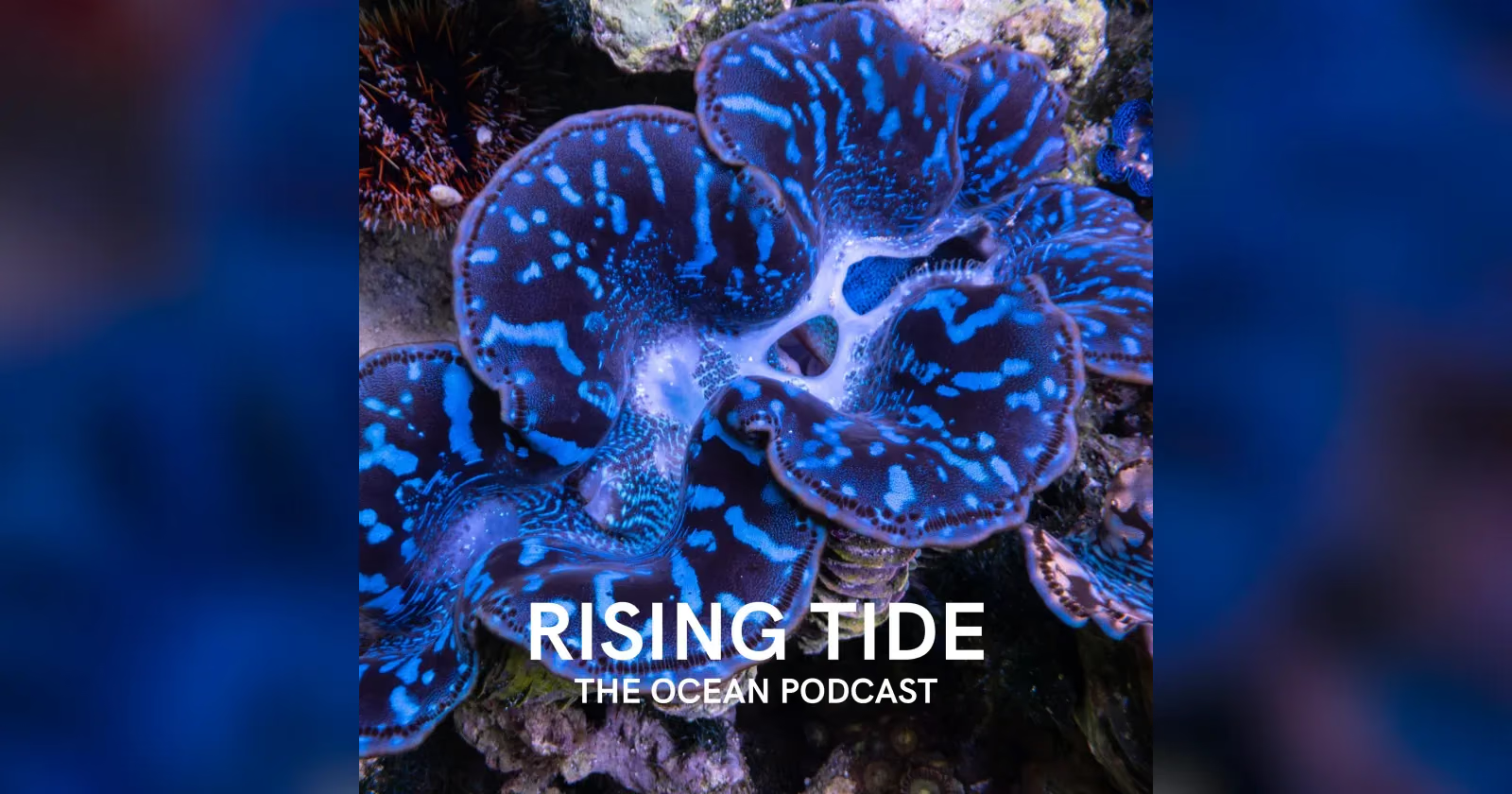
IMARCS Vice President and Lead Environmental Scientist Jordan Flagel joined David Helvarg of Blue Frontier and Vicki Nichols Goldstein of the Inland Ocean Coalition on episode 169 of Rising Tide: The Ocean Podcast. The conversation covered giant clams, the algae that power them, and whether those algae could help bleached corals recover.
From Calgary to the coast
Jordan first saw the ocean at about ten years old in Vancouver and wanted to be a marine biologist. University in Calgary took him into sustainability and environmental science instead. That path led to forest work in Guyana and then to Belize, where a job hired for his forest experience finally put him to work on reefs and mangroves.
Solar-powered mollusks
Giant clams live only in the Indo-Pacific, from the Red Sea through the Indian Ocean to the Great Barrier Reef. What separates them from other clams is the zooxanthellae in their mantles. The clams get energy from photosynthesis as well as filter feeding. The more surface area they have, the more zooxanthellae they can house, and the more water they can filter. A Tridacna gigas can filter thousands of liters in a relatively short time and grow past 200 kilograms and more than a meter across. The true giants are now very rare and among the most endangered.
The coral recovery question
The zooxanthellae in giant clams tend to be more thermally tolerant, at least across most giant clam species. That is the basis of IMARCS's biggest current project: determining whether zooxanthellae from Hippopus clams can be transferred into corals.
"We have previously bleached corals that have recovered and now contain zooxanthellae," Jordan said. "But we need genomic analysis to determine whether those are the same zooxanthellae found in the clams."
So far, the observed route in the wild is through clam fecal pellets taken up by some corals, in limited cases. IMARCS is testing whether a more direct transfer is possible, for example placing mantle tissue in a tank with bleached corals. A bleached coral has lost its zooxanthellae and may be open to taking up new ones. If those new algae are more heat tolerant, the coral might recover without waiting for the water to cool. The long-term goal is a nature-based approach rather than one that depends on lab tanks. See the full research programs.
Protecting wild clams, and the Saving NEMO Act
Giant clams have been harvested heavily for food and the ornamental trade, and they are slow to replace themselves. IMARCS submitted an official comment on the Saving NEMO Act. The concern is that restrictions on captive-bred trade could put more pressure on wild populations. IMARCS's partner in Micronesia, the Kosrae giant clam hatchery, is exactly the kind of source that could meet demand, but only if captive-bred clams can move internationally, including to IMARCS's lab in Japan. Jordan said he would support legislation that stops wild harvesting while making it easier to supply sustainably captive-bred animals. More background: Saving NEMO Will Not Save Reefs, or Livelihoods.
Carbon, shells, and proof of concept
Jordan was originally brought in for his work in mangrove conservation and carbon sequestration. One question he looked at was whether giant clams could be a net-negative carbon sink. From his reading, on their own they probably are not, because shell formation and respiration also release carbon. That is why IMARCS is testing whether changing the conditions can change the answer.
Shell building also depends on carbonate ions, which are less available in more acidic water. That affects giant clams and corals alike.
"Our purpose on the research side is to do proof-of-concept projects," he said. "We're asking: Is something even possible?" IMARCS is also using environmental DNA to study whether giant clams increase biodiversity around them, part of its broader reef restoration work.
From the tank to the reef
Could a result in the lab scale to something the size of the Great Barrier Reef? Jordan was direct: IMARCS tests novel ideas, and larger organizations with more funding would take on the question of scale. Many things that work in a lab are impossible in the field, which is why he values conservation so highly. Protecting what already exists lets nature do the work.
He added that technology has to fit into a more holistic approach that includes local communities, conservation groups, and researchers. On mangroves, he stressed that conservation projects need financing and have to prove they protect something that was actually threatened. Bad projects erode trust.
What gives him hope
"The resilience of nature itself," Jordan said. He pointed to Belize's reef, which has held up even as other reefs suffered severe bleaching. He also pointed to people. In Belize, taxi drivers and shop workers with no professional tie to conservation could tell him that mangroves store carbon and serve as fish nurseries. For more on that, hear Jordan's mangrove episode on Marine Conservation Happy Hour.
Listen and read more
Listen on the Rising Tide episode page, read David Helvarg's write-up of the conversation on Our Blue Frontier, and find past episodes at Rising Tide: The Ocean Podcast. Jordan's first giant clam episode is here: Giant clams, carbon, microplastics, and coral recovery.