
IMARCS is a US nonprofit running novel, hands-on marine research: restoring reefs and mangroves, and removing pollutants like microplastics from the water, with measurable, quantifiable results.
IMARCS runs its own novel research programs alongside field partners around the world, restoring reefs and mangroves, helping bleached coral recover, and pulling microplastics and other pollutants out of the water.
Pick the right animal and the science, the visuals, and the fundraising all line up. The giant clam does four jobs at once.
A single giant clam can process up to roughly 1,000 liters of seawater a day, which is why we study clams and mangroves together as a way to remove microplastics from the water.
Clams host heat-tolerant zooxanthellae, the same symbiotic algae that bleached corals lose. That link is the basis of our coral-recovery research.
Every giant clam species is threatened. We grow five of them (crocea, derasa, maxima, squamosa, and noae) for restoration, food security, and re-seeding lost habitat.
Threatened, colorful, and alive on camera. A clam is something a donor, a student, or an audience can watch, adopt, and understand in seconds.
We combine marine ecology, molecular genetics, and biogeochemistry with field partners in Micronesia, Vietnam, Belize, Spain, and Japan.
Studying giant clams and mangrove roots as paired biological filters, and working to quantify how much microplastic they capture from the water and sediment.
Testing whether heat-tolerant zooxanthellae from giant clams can help bleached corals recover, with samples analyzed at our University of Barcelona lab.
Field work to restore mangrove stands, re-seed lost giant-clam habitat, and monitor reef biodiversity alongside local researchers and partners.
Mangroves are among the best natural carbon stores on Earth. We are also testing whether controlled mariculture can shift clam shell growth toward measurable carbon storage.
Note for editors: carbon and microplastics work is framed as active research, not a finished or certified result. Every public claim is reviewed by our lead scientist first. Ask us for the current, citable version.
IMARCS is building a Japan-based education and research facility designed to make marine science visible, hands-on, and open to the next generation.
Copy-paste starting points for a piece, a segment, a caption, or a video. Each one is visual, specific, and stands on its own.
Microplastics are everywhere in the ocean, and two of nature's best filters are the giant clam and the mangrove. IMARCS is putting both to work and measuring the result.
Founder Gui Paphorn is a Karen refugee who fled persecution, was granted Thai citizenship, and now helps lead a global marine-science nonprofit that also serves Indigenous communities.
BusanBare, a Korean beauty brand, donates a dollar from every product sold to IMARCS microplastics research. A concrete model for how consumer brands can fund real science.
IMARCS is building a Japan-based facility where children, students, and families can watch coral propagation, giant-clam research, and microplastics cleanup happen in real time.
After a hard year for warm-water reefs, IMARCS is investigating whether heat-tolerant algae from giant clams could help corals adapt. We supply the carefully reviewed wording.
Every partnership is built to be low-friction on your side and high-visibility on ours. We bring the copy, the assets, and the impact reporting.
Cover the work or run one of our angles. We make you fast.
Turn everyday purchases into ocean cleanup, and get content back.
Share a mission your audience already cares about.
This Korean beauty brand donates $1 from every product sold to IMARCS to fund novel microplastics-cleanup research. No new checkout friction, a clear cause story, and a tax-deductible gift, all in one.
"Beauty shouldn't come at the ocean's expense. IMARCS is doing the microplastics research our industry can't ignore, so we give a dollar from every product we sell."
Christina Maddox, Co-Founder, BusanBare
You get content, links, differentiated cause marketing, and customer goodwill. IMARCS gets funding, reach, and credibility. Mix and match. We supply the kit for every one of these.
A one-time gift for a co-branded, SEO-strong blog post and a dofollow backlink from imarcs.org.
You gain link equity & content"Add $1 for ocean cleanup" at checkout, or round up to the nearest dollar. We provide copy, QR, and the page.
Passive, recurring, low-frictionThe BusanBare model: a fixed donation baked into each sale, with an "as seen supporting IMARCS" badge.
A built-in brand storyGift a symbolic clam adoption, certificate plus live updates, above an order threshold. Lifts average order value.
Drives AOV & repeat visitsA time-boxed matching campaign tied to World Oceans Day or Earth Day. We deliver the full campaign kit.
A reason to email your listA small product or merch run using the IMARCS clam artwork, with proceeds split. We supply art and story.
Scarcity & a fresh launchEquipment, materials, or services donated to a named research or education system, with on-camera credit.
Persistent brand placementSponsor a live research or propagation stream from the facility. A persistent logo on the work as it happens.
Always-on, low-cost goodwillFeature IMARCS in a send, and we feature you to our list and social channels. Reach for reach, no cash required.
Zero-cost audience tradeA small IMARCS QR on packing slips or receipts: "Your order helps clean up the ocean." Turns fulfillment into impact.
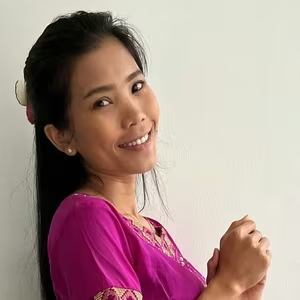
Uses space you already shipA member of the stateless Karen people, Gui fled military persecution in Myanmar before Thailand granted her citizenship. She founded IMARCS to protect both the natural environment and the Indigenous communities that depend on it. Business degree, Ratchaburi University.
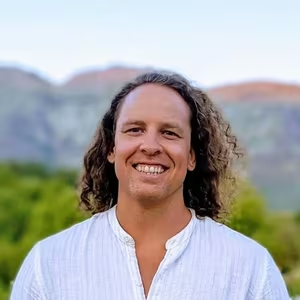
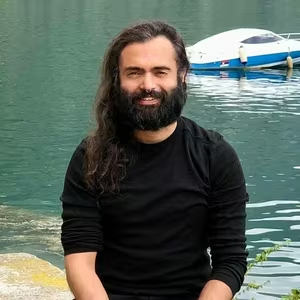
Two master's degrees in sustainable resource management and integrated science, then over a decade in reefs, mangroves, and tropical forests for NGOs and think tanks across Belize, Guyana, and Canada, including UN Green Corps and the IISD. Fellow at Canada's Energy Futures Lab and founder of Treebridge Conservation. He leads the science and reviews every public claim.
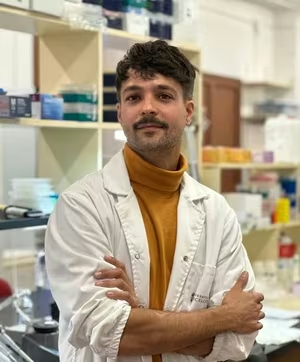
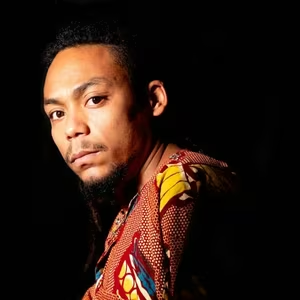
A marine biologist specializing in molluscs, Dr. Moles has helped describe dozens of new species using phylogenomics and high-throughput sequencing. He teaches invertebrate zoology and evolutionary biology at Harvard, LMU Munich, and the University of Barcelona.
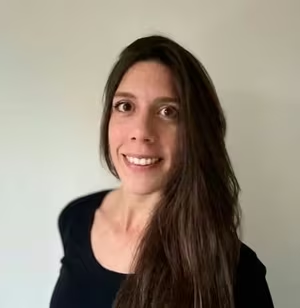
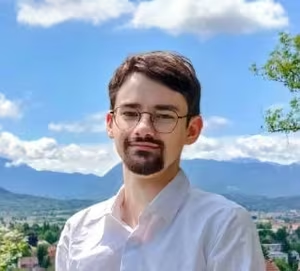
A marine molecular ecologist and Marie Skłodowska-Curie Fellow at the University of Barcelona, Dr. Arranz uses population genomics and eDNA metabarcoding to track how marine biodiversity adapts to rapid environmental change. PhD, University of Auckland; author of 17 peer-reviewed papers.
Tell us which lane fits and we will send the assets the same week. Press, brand, or creator, we make it easy.