

Our University of Barcelona connection: what it is, and what it isn't
If you've looked around our website, you've seen the University of Barcelona listed among the people we work with. A few of you have asked what that relationship actually is. It's a fair question, and the answer is a little unusual, so I want to lay it out plainly.
What it is
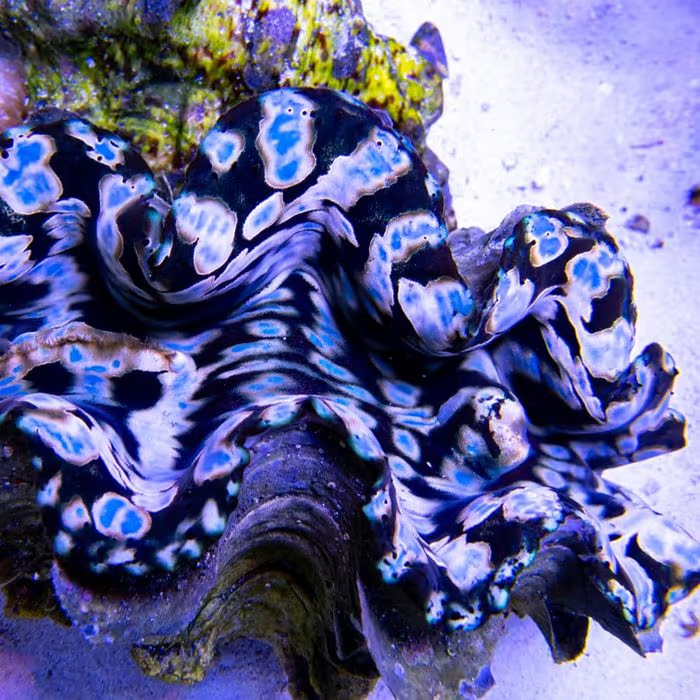
The University of Barcelona houses one of our team members as a part-time PhD student in marine biology. As a doctoral student, our team member has access to laboratory space at the university for thesis research, which is being done in tandem with our work at IMARCS. That lab is where we process the samples behind our symbiont research, including our work on whether the algae living inside giant clams can help bleached corals recover. From there, the samples go to specialized genomic labs for analysis, and our team writes up the results with the aim of publishing them in scientific journals.
Two scientists there have also generously agreed to advise IMARCS as volunteers:
- Dr. Vanessa Arranz, a marine molecular ecologist and Marie Skłodowska-Curie Fellow.
- Dr. Juan Moles, a mollusc specialist who has helped describe dozens of new species and previously held a postdoctoral position at Harvard.
Alongside advising, they take part in our ongoing research when they can and will help contribute to the publications that come out of it.
What it isn't
This is not an institutional partnership between the IMARCS Foundation and the University of Barcelona. To be specific:
- No financial role. The university does not fund IMARCS and has no financial stake in our work.
- No institutional role. There is no formal agreement between IMARCS and the university. The university has not reviewed, approved, or endorsed IMARCS or its programs; they have only approved the lead researcher to conduct thesis research, which is also IMARCS research.
- No official faculty role. Dr. Arranz and Dr. Moles advise IMARCS in a personal, voluntary capacity. They do not represent the university when they do.
Essentially, this partnership is about sharing lab space, voluntarily sharing expertise, and a great deal of goodwill.
Why it works
For a small foundation, that combination matters more than it might sound. A working molecular lab, plus two experienced researchers willing to check our methods and challenge our assumptions, makes our science better. Formal institutional partnerships take years to build. This one grew out of shared curiosity about giant clams and corals.
Why we're spelling it out
Accuracy matters to us. We would rather describe a relationship exactly as it is than let anyone assume a backing we don't have. When you see the University of Barcelona on our site, this is what it means.
To Vanessa and Juan: thank you. Your generosity is a big part of why this research is moving forward.
Jordan Flagel