

Reefs and mangroves: the partnership that protects life on land
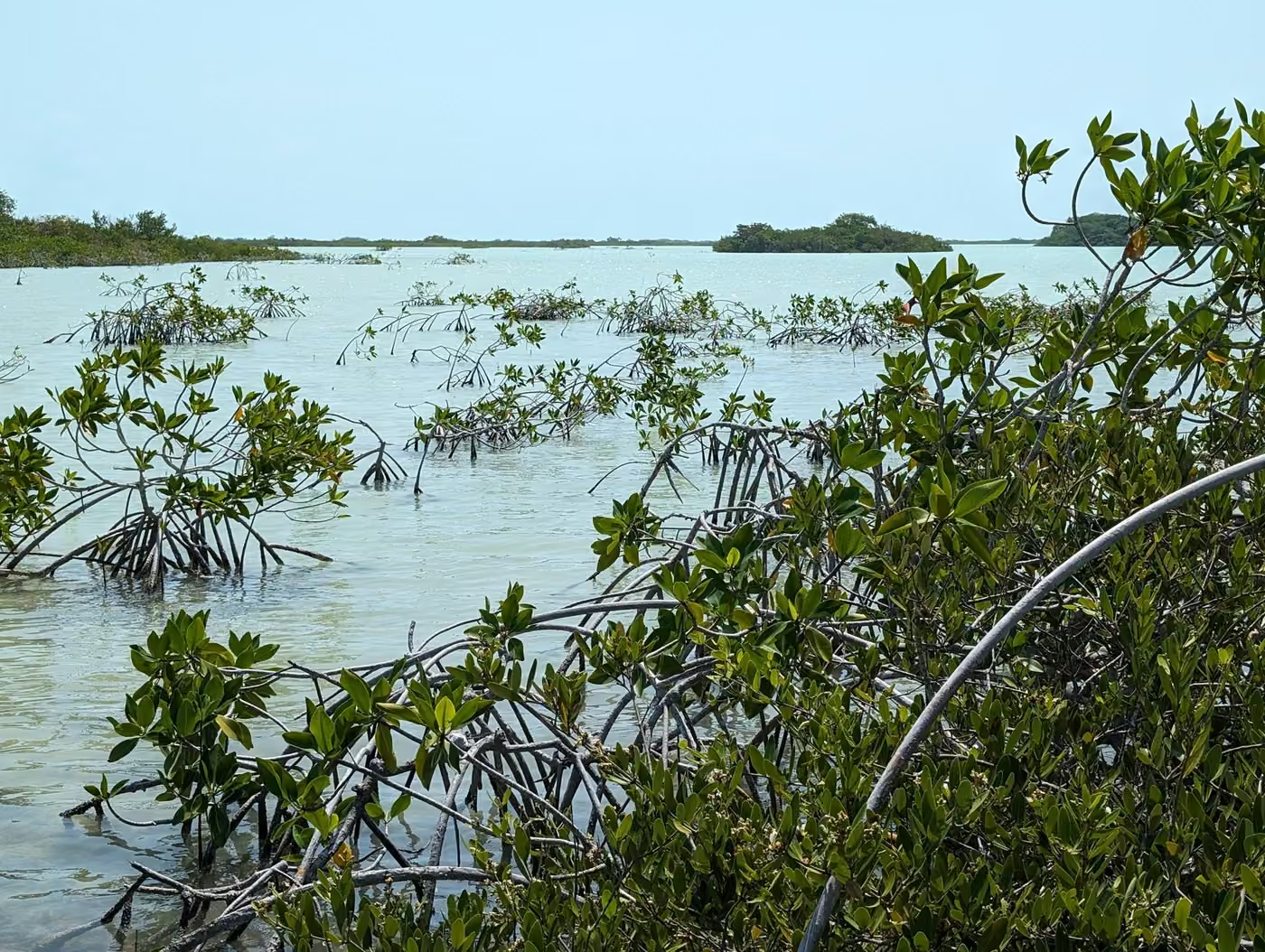
Stand on a tropical shoreline and you can often see two very different worlds within sight of each other. At the waterline there's the tangle of a mangrove forest, its roots arching down into the shallows. Farther out there's a pale line of breaking waves where the sea runs over a coral reef. They look like separate places. In practice they work as a team, and a surprising share of what that team does benefits people on land.
Two ecosystems, one coastline
Coral reefs cover less than 1% of the ocean floor, yet they support an estimated quarter of all known marine species (NOAA). Mangroves are salt-tolerant trees that grow along ocean coastlines throughout the tropics (Donato et al., 2011).
What ties them together is movement. Many reef fish spend their early lives among mangrove roots, where the water is shallow and the cover is dense, and then move out to the reef as adults. A landmark study along the Mesoamerican Reef in Belize and Mexico found that mangroves strongly shape the fish communities on nearby reefs. Where adult reef habitat was connected to mangroves, the biomass of several commercially important species more than doubled (Mumby et al., 2004). The same study found that the rainbow parrotfish, the largest plant-eating fish in the Atlantic, depends on mangroves and has disappeared locally where they were removed.
The help runs the other way too. Reefs act as natural breakwaters. A global analysis found that coral reefs reduce incoming wave energy by an average of 97%, with the shallow reef crest doing most of that work (Ferrario et al., 2014). That shelter reduces erosion along the shore and helps create the calmer conditions that coastal wetlands need (Guannel et al., 2016).
Why this matters on land
Storm and flood protection. Mangroves slow water as it moves inland. A global study estimated that mangroves provide more than US$65 billion a year in flood protection, and that without them about 15 million more people would be flooded every year (Menéndez et al., 2020). Coral reefs add another layer: the same wave study estimated that 100 million or more people may benefit from the risk reduction reefs provide (Ferrario et al., 2014).
Stronger together. A modelling study based on the Belize coastline compared reefs, seagrass meadows and mangroves, alone and in combination. Together, the three supplied more coastal protection than any single habitat or any pair of them (Guannel et al., 2016). The same work showed that live coral matters: reefs with living coral reduced wave height far more than dead reefs. Protecting one of these habitats while the others decline leaves a coastline weaker than it looks.
Food and livelihoods. Because mangroves act as nurseries for reef fish, they feed directly into the fisheries that coastal families rely on (Mumby et al., 2004). Healthy reefs, in turn, support the fishing and tourism that many coastal economies are built around.
Carbon. Mangroves are among the most carbon-rich forests in the tropics. A study of mangroves across the Indo-Pacific found they hold on average about 1,023 tonnes of carbon per hectare, much of it in deep, waterlogged soils (Donato et al., 2011). The same study noted that mangrove area has declined by 30 to 50% over the past half century. When mangroves are cleared, much of that stored carbon is at risk of being released.
When one is lost, the other suffers
Because the two systems lean on each other, damage travels. Clear the mangroves and nearby reefs lose a nursery that supplies many of their fish. Lose the living coral on a reef and more wave energy reaches the shore, the seagrass and the mangroves behind it. The researchers behind the Belize and Mexico fish study drew a simple conclusion from their results: conservation should protect connected corridors of mangroves, seagrass and coral reefs, not isolated pieces (Mumby et al., 2004).
Where IMARCS fits
This is why our work stretches from giant clams and corals to coastal mangroves. Our clam and coral research focuses on keeping reefs alive through warming seas, and our work in Belize looks at mangrove conservation, its carbon storage and its effects on biodiversity. They're two ends of the same coastline.
In two weeks, we'll look at how Belize protects its reefs and mangroves, and what other countries can learn from it.
References:
- Donato, D. C., Kauffman, J. B., Murdiyarso, D., Kurnianto, S., Stidham, M., & Kanninen, M. (2011). Mangroves among the most carbon-rich forests in the tropics. Nature Geoscience, 4, 293-297. https://doi.org/10.1038/ngeo1123
- Ferrario, F., Beck, M. W., Storlazzi, C. D., Micheli, F., Shepard, C. C., & Airoldi, L. (2014). The effectiveness of coral reefs for coastal hazard risk reduction and adaptation. Nature Communications, 5, 3794. https://doi.org/10.1038/ncomms4794
- Guannel, G., Arkema, K., Ruggiero, P., & Verutes, G. (2016). The power of three: Coral reefs, seagrasses and mangroves protect coastal regions and increase their resilience. PLOS ONE, 11(7), e0158094. https://doi.org/10.1371/journal.pone.0158094
- Menéndez, P., Losada, I. J., Torres-Ortega, S., Narayan, S., & Beck, M. W. (2020). The global flood protection benefits of mangroves. Scientific Reports, 10. https://doi.org/10.1038/s41598-020-61136-6
- Mumby, P. J., Edwards, A. J., Arias-González, J. E., et al. (2004). Mangroves enhance the biomass of coral reef fish communities in the Caribbean. Nature, 427, 533-536. https://doi.org/10.1038/nature02286
- NOAA Florida Keys National Marine Sanctuary. Coral reef biodiversity. https://floridakeys.noaa.gov/corals/biodiversity.html